And the Spirit & the bride say, come.... Reveaaltion 22:17

And the Spirit & the bride say, come.... Reveaaltion 22:17
And the Spirit & the bride say, come...Revelation 22:17 - May We One Day Bow Down In The DUST At HIS FEET ...... {click on blog TITLE at top to refresh page}---QUESTION: ...when the Son of man cometh, shall he find faith on the earth? LUKE 18:8
Showing posts with label BABEL. Show all posts

Saturday, July 5, 2025

Creation Moment 7/6/2025 - Adam & Eve's Skin Color

Then God blessed them, and God said to them, Be fruitful and multiply; fill the earth and subdue it; have dominion over the fish of the sea, over the birds of the air, and over every living thing that moves on the earth. Genesis 1:28 NKJV

"In Western countries, nearly every imaginative painting of Adam and Eve depicts two adult Caucasians with fair skin and blue eyes. These images, even when used as Bible illustrations, tend to shape the reader's mental image of the first man and woman. The origin of the darker-skinned races is often that they were descendants of Adam and Eve who had migrated to a hot climate where the suntan eventually became an inherited characteristic.
These images and explanations discredit Christianity.

The true explanation began to be resolved when it was shown that
human beings carry two genes for color and that each gene consists of "
black" or "white" alleles. One allele was received from the mother and the other from the father. The allele is part of the gene, and the gene is part of the DNA – while the DNA resides in the nucleus of every cell in our body. Our skin color is caused by the pigment melanin, and this is controlled by two pairs of genes that geneticists refer to using the letter designations Aa and Bb, where the capital letter represents dominant genes and the small letters represent recessive genes.

A and B, being dominant, produce melanin in good quantity, while recessive a and b produce only a minor amount of melanin. Hence, our coloration depends upon the number of black and white alleles we received from our parents. The color genes express themselves in only one place – specialized skin cells called the melanocytes – that produce granules of melanin that are delivered to neighboring cells.

Eve was made from Adam's rib and was thus a clone of Adam [Genesis 2:21-22]. They would therefore have had identical genes for melanin production. If they were both AABB, they would have been black and produced children of only the darkest coloration. If this were the case, the world's population today would be entirely Negro.

In fact, only around 10-14% of the world's population is black, so we can be certain that our first parents were not of the AABB combination. By the same argument, if Adam and Eve had both been aabb, all their children would have been aabb, meaning that all their descendants would be the lightest Caucasian possible – there would be no other colors. Clearly, this is not the case, so by a process of deduction, we can conclude that Adam and Eve were heterozygous, each having two dominant and two recessive genes, AaBb.

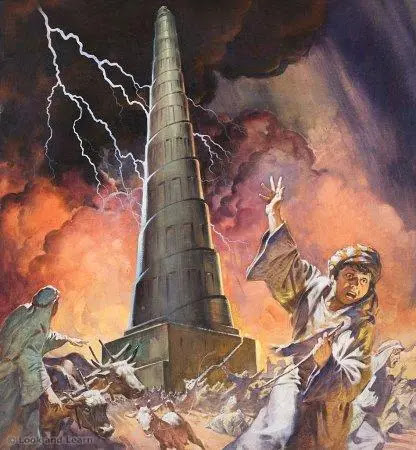
These color differences were likely amplified following the business at the Tower of Babel [Genesis 11:1-9] when the human gene pool was divided.

Loss of genetic information in an isolated population is well known and a documented problem for breeders of pure-bred dogs, horses, and other animals. It seems that one population group that migrated from the Tower of Babel suffered a greater loss of the genetic information required to produce melanin and became the Caucasians.

The bottom line is that Adam and Eve were not white or black but a good middle brown.
CM

Wednesday, June 25, 2025

Debate over Babel Settlement

"Who settled at Shinar (Babel) in Genesis 11:1–9?
Q: Was it all the people of the earth or only a particular group of
people? 

--The traditional Biblical creationist answer to this question is that all the people of the earth settled at Shinar. 
--However, some Biblical creationists have diverted from this position and argue that, after the flood, Genesis 10 documents groups of people spreading out over the earth and that Genesis 11 gives the explanation of one of those groups of people migrating to a plain in Shinar to build the world’s first major city. 
The most prominent proponent of this position, Dr. Douglas Petrovich, comments on Genesis 11:1–2:
"During the time when all mankind on the surface of the earth conversed with a single, universal language, some undefined number of them moved westward and settled on a plain that was in the land of Shinar (Šumer, from Akkadian, Šumeru). . . . It is a misconception of ours to think that the Biblical text [Genesis 11:1–2] is saying all of the people who were existing on the earth went to one place and lived there. The Bible never says that that is in our conceptions, and that is a wrong conception we read into the text."
Petrovich believes Genesis 11 describes a technologically advanced people who were suddenly dispersed throughout the ancient Near East. He concludes that the evidence that best describes people moving toward urban living in one place is found in Eridu, southern Šumer, southern Mesopotamia. Petrovich, who follows the chronology of the Septuagint (LXX) in Genesis 11, believes this took place roughly 500 years after the flood (c. 3168 BC) around 2650 BC. There are, however, textual reasons why the Masoretic Text (MT) should be seen as being superior to the Septuagint in Genesis 5 and 11.

Q: Is it true that only some undefined number of people settled at Shinar?
Genesis 10 is divided into three sections, one for each son: Japheth (10:2–5), Ham (10:6–20), and Shem (10:21–31). In each genealogy, there is a reoccurring pattern; people spread (Genesis 10:32) into “lands,” “languages,” “clans,” and “nations” (Genesis 10:5, 20, 31).

Kenneth Mathews notes, 
“This rearrangement sandwiches the tower incident between the two accounts of the Shem genealogy (10:21–31; 11:10–26). It also shows that the tower debacle resulted in the dispersion of the nations, of which Shem’s descendants were a part.”
The first genealogy (10:21–31) completes the table of nations and leads to the Babel event: (Shem → Eber → Peleg). The second genealogy (11:10–26) continues with the direct descendants of Shem (Shem → Eber → Terah) and leads to the account of the call of Abraham.

Genesis 11 commences with the whole earth speaking one language, and so, it sets the narrative chronologically before Genesis 10, as there the nations are arranged by their own languages. It is common
in Genesis to give the explanation of the event after the narration of the event (cf.
Genesis 1:26–28, 2:7, 22). The confusion of the one language at Babel (Genesis 11:9) is the reason why there are multiple languages in Genesis 10. Genesis 11 tells us how and why the dispersal of languages and peoples across the whole earth happened in Genesis 10.

The actual time of the dispersal at Babel most likely took place in the days of Peleg (Genesis 10:25). Although exactly at what point in Peleg’s life is debated. Based on the MT, if the dispersion is linked with Peleg’s birth, then this suggests the Babel incident occurred around 106 years after the flood. If the dispersion happened at the end Peleg’s life, then this is around 340 years after the flood. Alternatively, the phrase “in his days” (בימיו) could indicate that it happened during his lifespan or at a time when he was prominent.

Genesis 11:1 introduces the unity of mankind, “Now the whole earth had one language and the same words.” The first verse beings with the phrase “the whole earth” (kol-hāʾāreṣ). The phrase “the whole earth” appears five times in nine verses (vv. 1, 4, 8, and twice in v. 9). Significantly, Genesis 11:1–9 begins and ends with the phrase “the whole earth.” 
Since the dispersion from Babel is tied to the table of nations (Genesis 10), the context would indicate that the phrase “the whole earth” refers to all the people of the earth collectively.

Q: How large was the population of people who settled at Babel? 
A: It could have been anything from 1,000 to 10,000 people. This would be enough people to build a city and a tower.

The Babel narrative ends the way it began, with a reference to all the earth, “Therefore its name was called Babel, because there the Lord confused the language of all the earth. And from there the Lord dispersed them over the face of all the earth” (Genesis 11:9). It was at Babel that God confused the language of all the earth. But if all the earth did not settle at Shinar and it was only a group of post-flood people, then how did God confuse the language of all the earth at Babel (Genesis 11:9)? 
The disobedience of the people at Babel caused God to reverse their plan by confusing the language of all the earth and dispersing them over the face of the earth (Genesis 11:8–9)." 
AIG

Saturday, April 5, 2025

Why the Tower of Babel event is Significant

And the LORD came down to see the city and the tower, which the children of men builded. Genesis 11:5

"The Babel event is crucial for several reasons:
--It demonstrates human rebellion: The tower of Babel illustrates
humanity’s tendency to rebel against God’s commands, seeking to establish their own authority and unity apart from him.

--
It explains linguistic diversity: It provides a Biblical explanation for the diversity of languages, which aligns with the observable linguistic differences we see today.
--
It explains the foundation for nations: The dispersion at Babel set the stage for the formation of different nations and cultures, all descending from Noah’s family.
*
The Tower of Babel serves as a reminder of the futility of human pride and the importance of obedience to God." 
AIG

Thursday, January 9, 2025

Phonemes tell us.......

Therefore is the name of it called Babel; because the LORD did there confound the language of all the earth: and from thence did the LORD scatter them abroad upon the face of all the earth. Genesis 11:9

"Psychologist Quentin Atkinson counted distinct units of sound, called phonemes, in 504 of the world’s nearly 7,000 languages. 
He found that sub-Saharan African languages average the most phonemes, while language groups farther away have fewer phonemes
These findings, published in Science, are consistent with the principle that “when a very small number of individuals break off from a larger population, there is a gradual loss” of linguistic complexity.

Controversy in the linguistic community is being stirred up by another recent study, this one from Nature. Researchers analyzed the grammatical rules of word order in several language groups and found that the patterns were too random to construct an evolutionary language tree.

The findings of these studies are consistent with a Biblical worldview, so long as evolutionary presuppositions are ignored. 
God gave Adam and Eve language when He made them about 6,000 years ago. 
When people rebelled at the Tower of Babel, God confused their language. 
Their new languages then lost complexity as small people groups spread out. The languages created then were the forerunners of today’s languages." 
AIG

Wednesday, December 11, 2024

Because they stopped in their migration.......

"Allowing that the human race multiplied on the earth after the flood in the ratio that the Israelites did in Egypt, their numbers would double once in fourteen years, or seventeen times in two hundred and forty years. 
---If so, they would number at this time more than a million of souls,-a number sufficiently large to begin to scatter abroad over the face of the earth. 

The division of the nations "in the earth after the flood" was divinely appointed; for God "made of one blood all nations of men for to dwell on all the face of the earth, and hath determined the times before appointed, and the bounds of their habitation." 
Genesis 10:32/Acts 17:26

To this division some rebelled; for we read: "And it came to pass, as
they journeyed from the east, that they found a plain in the land of Shinar; and they dwelt there. . . . And they said, Go to, let us build us a city, and a tower, whose top may reach unto heaven; and let us make us a name, lest we be scattered abroad upon the face of the whole earth.
" Genesis 11:2, 4
The leader in this rebellion is supposed to have been Nimrod, whose name signifies the rebellious. 
He was the Belus of the ancients, a great-grandson of Noah, being the youngest son of Cush, a son of Ham. "He began to be a mighty one in the earth. . . . And the beginning of his kingdom was Babel . . . in the land of Shinar." Genesis 10:8, 10

Because they stopped in their migration, God confounded their language, that they might not "understand one another's speech. . . . So the Lord scattered them abroad from thence upon the face of all the earth; and they left off to build the city. Therefore is the name of it called Babel; . . . and from thence did the Lord scatter them abroad upon the face of all the earth." Genesis 11:7-9."
Sylvester Bliss

Saturday, June 15, 2024

Seven Sisters Point to Babel

"A Winston Churchill Fellow, Australian Aboriginal woman Susie Betts, studied indigenous creation stories involving the Seven Sisters star constellation, or the Pleiades.
Her research took her to North and South America.

She anticipated similarities with her own Wirangu people’s creation
story. In this, the ‘Orion the hunter’ constellation (the hunter ‘Tgilby’ in their language) falls in love with and chases the
Seven Sisters (‘Yugarilya’).

And so it proved. “Her research found Indigenous people from across the globe shared creation links to the Seven Sisters constellation.”

Q: But why should cultures as geographically diverse as these and others (e.g., ancient Greece, Ukraine) similarly regard the stars in the Pleiades as seven women? 
Q: And most often sisters? 
Q: And chased by a hunter? 
The oldest known Greek mythologist Hesiod (8th century BC) had a line “Pleiades flee mighty Orion”. The book of Job, probably the oldest completed book of the Bible, records God asking Job, “Can you bind the chains of the Pleiades or loose the cords of Orion?” (Job 38:31).

It would be very difficult to explain from an evolutionary/long-age perspective! Nothing about the stars’ appearance suggests sisters—or even women. Also, why would the same star pattern suggest a hunter to both the ancient Greeks and to the Wirangu people? So, it would be a remarkable coincidence if the stars-to-sisters connection had occurred more than once by chance—let alone in cultures across the globe!

Rather, this points to the truth of the Bible’s account of the dispersal from Babel, just a few thousand years ago."
CMI

Sunday, April 7, 2024

Archaeology: Post-Babel Canoes?

 So the LORD scattered them abroad from thence upon the face of all the earth: and they left off to build the city. Genesis 11:8

Could these be within a century or so of Babel?

"Many of the most important civilizations in Europe originated on the shores of the Mediterranean Sea.
Phoenicians, Greeks, Romans and Carthaginians plied that practically enclosed sea to move rapidly along its coasts and between its islands. 
Dr. Juan Gibaja from the Spanish National Research Council and his colleagues examined five dugout canoes — built from hollowed-out
trees  — from the
 Neolithic lakeshore village of La Marmotta, near RomeItaly.

The analysis reveals that the canoes are built from four different types of wood, unusual among similar sites, and that they include advanced construction techniques such as transverse reinforcements.
One canoe is also associated with three T-shaped wooden objects, each with a series of holes that were likely used to fasten ropes tied to sails or other nautical elements.
These features, along with previous reconstruction experiments, indicate these were seaworthy vessels, a conclusion supported by the presence at the site of stone tools linked to nearby islands.

Similarities between these canoes and more recent nautical technologies support the idea that many major advances in sailing were made during the early Neolithic
Our study reveals the amazing technological sophistication of early agricultural and pastoral communities, highlighting their woodworking skills and the construction of complex vessels." 
SciNews

Thursday, August 3, 2023

Sumerian Enmerkar's Speech: Echoes of Babel?

"After the Flood, as the human population quickly grew, some descendants of Noah built a tower to prevent their dispersion; but God “confounded their language” (Gen. 11:1-8), and they were scattered over the whole Earth. Up until this time “the whole Earth was of one language and of one speech.” 
In the Sumerian epic entitled Enmerkar and the Lord of Aratta, in a speech of Enmerkar, an incantation is pronounced that has a mythical introduction.

Kramer’s translation is as follows:
Once upon a time there was no snake, there was no scorpion,
There was no hyena, there was no lion, 
There was no wild dog, no wolf,
There was no fear, no terror,
Man had no rival.
In those days, the lands of Subur (and) Hamazi,
Harmony-tongued Sumer, the great land of the decrees of princeship,
Uri, the land having all that is appropriate,
The land Martu, resting in security,
The whole universe, the people in unison
To Enlil in one tongue [spoke].
(Then) Enki, the lord of abundance (whose) commands are trustworthy,
The lord of wisdom, who understands the land,
The leader of the gods,
Endowed with wisdom, the lord of Eridu
Changed the speech in their mouths,
 [brought] contention into it,
Into the speech of man that
 (until then) had been one.
CradleOfCivilization

Saturday, June 24, 2023

Choctaw Echoes of Creation & Babel

And they said, Go to, let us build us a city and a tower, whose top may reach unto heaven; ...Therefore is the name of it called Babel; because the LORD did there confound the language of all the earth: and from thence did the LORD scatter them abroad upon the face of all the earth. Genesis 11:4,9

It is documented that the Choctaw Indians of  Bayou Lacombe believed the following about Creation and Allusions to Babel BEFORE their Christianization by Adrien Roquette (*see Roquette sidenote).
 
"Thunder and lightning are to the Choctaw two great birds - Thunder (Heloha), the female; Lightning (Mala'tha), the male. 
Many generations ago Aba, the good spirit above, created many
men, all
Choctaw, who spoke the language of the Choctaw, and understood one another. 
These came from the bosom of the earth, being formed of yellow clay, and no men had ever lived before them. 
One day all came together and, looking upward, wondered what the clouds and the blue expanse above might be. They continued to wonder and talk among themselves and at last determined to endeavor to reach the sky
So they brought many rocks and began building a mound that was to have touched the heavens. That night, however, the wind blew strong from above and the rocks fell from the mound. The second morning they again began work on the mound, but as the men slept that night the rocks were again scattered by the winds. Once more, on the third morning, the builders set to their task. But once more, as the men lay near the mound that night, wrapped in slumber, the winds came with so great force that the rocks were hurled down on them. 
The men were not killed, but when daylight came and they made their way from beneath the rocks and began to speak to one another, all were astounded as well as alarmed - they spoke various languages and could not understand one another
Some continued thenceforward to speak the original tongue, the language of the Choctaw, and from these sprung the Choctaw tribe. The others, who could not understand this language, began to fight among themselves. Finally they separated. The Choctaw remained the original people; the others scattered, some going north, some east, and others west, and formed various tribes." 
THE CHOCTAW OF BAYOU LACOMB By David I. Bushnell, Jr.
 
* Roquette Sidenote-  Adrien Rouquette (1813-1887) was the priest who converted the Choctaw of Bayou Lacombe around Lacombe, Louisiana.
---His father was a French immigrant from Bordeaux, France and served at the Battle of New Orleans under Andrew Jackson. Four years later he committed suicide by jumping off a cliff into the Mississippi River when his wine store when bankrupt.
---His mother, Louise Cousin, was the sister of my g-g-g-g-grandfather, Jean François Cousin Jr.
---When his mother died he was raised by his uncle Jean (himself had fathered children by a Choctaw, Rose Aimee, of whom he had my g-g-g-grandfather). 
---Adrien was sent to College in Nantes France, Kentucky and
The Great Oak Tree
Philadelphia.
He earned degrees in Law & Medicine. Then decided to become a priest instead in New Orleans. He also gave the keynote speech for the anniversary of the Battle of New Orleans in the city at one time. He authored many books, including a translation of the Choctaw Language.
---One day he upped and moved across Lake Ponchartrain from New Orleans to Lacombe (where his uncle Jean owned much of the land at the time) to be a missionary to the Choctaw. He lived among them and began to teach around a great oak tree, which still stands.
---He was given the name Chahta-Ima by the Choctaw, which means
"to be like a Choctaw". From that time on he always signed his name as that. He spent nearly a quarter of a century living among them and dressing like them.
---His last year of his life he had to be cared for by nuns in New Orleans because of bouts of dementia. He was unaware of where he was and thought he was in his old boyhood home, yet would talk of his poetry, religion and his his mission work. He was also fond of various Protestant denominations. While being cared for, he grew a white beard and was visited by Choctaw children who would bring him dainties.
---His death came 3 days after he had regained strength to get out of bed. The nuns rejoiced of his recovery but one night was too weak to get out of bed. His probation closed while in his sleep that night.
---When he died, his funeral procession through the streets of New Orleans drew thousands and his wagon was followed by Choctaw children with wreaths and flowers. At his grave, when Chahta-Ima's casket was lowered, the children gathered around it and wept.

Saturday, March 4, 2023

Genetic Clues from the Tower of Babel

"The Tower of Babel .....like the Creation and Flood accounts, there are only a couple of verses that apply to our model of genetics. But, like the others, these verses are as profound as they are simple.
Now the whole earth had one language and one speech.Gen 11:1
And they said, ‘Come, let us build ourselves a city, and a tower whose top is in the heavens; let us make a name for ourselves, lest we be scattered abroad over the face of the whole earth.’” Gen 11:4
It sounds like they were in a homogenous culture, but what do people in that situation do? Would you expect them to mix freely?
 
Note in Gen 11:4 that they knew about the potential for spreading
out and getting separated from one another and intentionally did the opposite! However, this was against the express command of God, who had ordered them to spread out (to populate the earth). So, He took matters into His own hands.
Come, let Us go down and confuse their language, that they may not understand one another’s speech.’ So the Lord scattered them abroad from there over the face of all the earth, and they ceased building the city.Gen 11:7–8
There are tremendous implications that come from the Babel account
---- It explains the amazing cultural connectivity of ancient peoples—like pyramid building, common flood legends, and ancient, non-Christian genealogies that link people back to biblical figures (e.g., many of the royal houses of pagan northern Europe go back to Japheth, the son of Noah).
 
From a Biblical perspective, the current human population easily fits
into the standard model of population growth using very conservative parameters. In fact, starting with 6 people and doubling the population every 150 years more than accounts for the current human population (a growth rate of less than 0.5% per year!). Population size would have increased quickly given the rate at which the post-Flood population reestablished agriculture, animal husbandry, industry and civilization. 
Q: So we must ask the question, “Why are there so few people in the world today?” 
A: The answer is that the world is young and we have not been here many thousands of years.
 
Q: When did the dispersion occur? 
A: Our best clue about the timing of the event comes from Genesis 10:25. In referencing the 5th generation descendent of Shem, a man named Peleg, it says, “in his days the earth was divided.” 
Q: To what is this referring? 
A: ....this passage is referring to the division of people at Babel.
There are 16 named sons born to the three brothers, Shem, Ham and
Japheth. If we assume about the same number of daughters, Noah had on the order of 30 grandchildren. At that rate of growth, there would have been about 150 children in Salah’s generation, about 750 in Eber’s generation, and about 3,750 in Peleg’s generation. Of course, these generations overlap, etc., so let’s say there were between 1,000 and 10,000 people alive at the time of Babel. This fits nicely with the available data. It is a high rate of growth, but wars and disease had yet to start taking their toll.
 
There is one more verse in this section that we need to discuss:
These were the families of the sons of Noah, according to their generations, in their nations; and from these the nations were divided on the earth after the flood.Gen 10:32
---At Babel, God did not separate the nations according to language. ---He used language to separate them according to paternal (male) ancestry! 
---This has monumental significance and is the key to understanding human genetic history. 
---Paternal sorting would lead to specific Y chromosome lineages in different geographical locations. Since males and females from the three main families should have been freely intermixing prior to this, it also leads to a mixing of the mitochondrial lines. 
*It is as if God put all the people into a giant spreadsheet and hit a button called “Sort According to Father.” He then took that list and used it to divide up and separate the nations.
 
We already saw that Y chromosomes have little variation among
them. We now add the fact that this little bit of variation is almost always geographically specific. That is, after the nations were separated according to Y chromosome, mutations occurred in the various lines. Since the lines were sent to specific geographical areas, the mutations are geographically specific. The current distribution of Y chromosome lines is a tremendous confirmation of the Biblical model.
 
Mitochondrial DNA (mtDNA) adds another confirmation. We have
already learned that there are three main lineages of mtDNA. We now add the fact that these three lineages are more or less randomly distributed across the world. Also, the various mutations within each of the three main families of mtDNA are geographically specific as well.
 
---In other words, as the three mixed mitochondrial lines were carried along with the Y chromosome dispersal, each line in each area began to pick up new mutations, just like we would predict." CMI

Sunday, February 5, 2023

Josephus on Nimrod

"In Genesis 11:4, the people say, “Come, let us build ourselves a city, with a tower that reaches to the heaven”. 
If Nimrod founded the city of Babel, it is likely he would have been part of this plan.
 
Josephus states of Nimrod 
He also said he would be revenged on God, if he should have
a mind to drown the world again; for that he would build a tower too high for the waters to be able to reach and that he would avenge himself on God for destroying their forefathers
 
(Antiquities of the Jews, Book 1, Chapter 4)."  
Croswsalk

Friday, September 16, 2022

Paths From Babel: A Glimpse into Babel Technology? (Pakistan/India)

So the LORD scattered them abroad from thence upon the face of all the earth... Genesis 11:8 

"The ancient city of Mohenjo Daro, the best preserved city from the Bronze Age, is located in Pakistan's southern Sindh province. It was a part of Indus Valley Civilization.....it was one of the world's oldest urban civilizations situated in the northwestern region of the Indian subcontinent, and consisting of what is now present-day Pakistan and northwest India......believed to have had a population of some five million
people. One of the most famous and well-preserved cities of this civilization is Mohenjo Daro. The inhabitants of this city were skilled urban planners and traders, as the discoveries made within the city suggests.
They also had a knack for controlling the water of river Indus, and they built wells and a proper drainage system with bathing areas and flushing toilets.
Mohenjo Daro
means "Mound of the Dead" in Sindhi language. The city's original name is unknown, but analysis of the city's seal suggests a possible ancient Dravidian name, Kukkutarma, as stated by the research paper, The Chronology of Indus Valley Civilization.....the city had a proper writing system, urban centers, and diversified social and economic systems. At its height of development....Following last month's floods, Pakistan is currently one-third under water. Millions of people have been displaced from their homes and more than 1,300 people have died. The extensive damage is seen in the heritage sites across the country too. The ruins of Mohenjo Daro have been affected as well."
Sputnik

Thursday, August 11, 2022

Paths from Babel: All the way to Amazonia

Therefore is the name of it called Babel; because the LORD did there confound the language of all the earth: and from thence did the LORD scatter them abroad upon the face of all the earth.
Genesis 11:9
 
"LiDAR (light detection and ranging) has documented 26 settlement sites, including two remarkably large, of the Casarabe culture in the Llanos de Mojos, Bolivia. The discovery challenges the view of Amazonia as a historically pristine landscape, but was instead home to an early urbanism created and managed by indigenous populations for thousands of years.
They found an unprecedented array of elaborate and intricate structures unlike any previously discovered in the region, including 5-m-high terraces and 21-m-tall conical pyramids.
Our LiDAR system has revealed built terraces, straight causeways, enclosures with checkpoints, and water reservoirs,” Professor Iriarte said. “There are monumental structures are just a mile apart
connected by 965 km of canals long raised causeways connecting sites, reservoirs and lakes.
” 
The central role of Cotoca as a primary site is also underlined by the impressive system of canals and causeways that radiate from the base platform in all of the cardinal directions, connecting with lower-tier sites, the Ibare River to the south, and lakes to the east.
This region was one of the earliest occupied by humans in Amazonia, where people started to domesticate crops of global importance such as manioc and rice.
The architectural layout of Casarabe culture large settlement sites indicates that the inhabitants of this region created a new social and public landscape.
The orientation of the buildings that constitute the civic-ceremonial centers of the two large settlement sites is very uniform towards the north-northwest. This probably reflects a cosmological world view, which is also present in the orientation of extended burials of the Casarabe culture."
SciNews/Nature

Thursday, July 28, 2022

IN the NEWS - Babel 2024 in the name of Mother Earth?

Modern Day Throwback to Babel---a city where man tries to save himself & the earth. And they said, Go to, let us build us a city and a tower, whose top may reach unto heaven; and let us make us a name, lest we be scattered abroad upon the face of the whole earth. Genesis 11:4
 
"Saudi Arabia shared an advertisement for a titanic megacity project
it has proposed.
The project, simply referred to as “The Line,” is a smart megacity project being proposed in the planned city of Neom, in the northwestern part of the country. 
The ambitious project will be just about 650 feet wide and 1,600 feet tall, but is planned to stretch for just under 106 miles long. The project’s website claims that once it is completed, the city will be home to some 9 million residents.
 “For too long, humanity has existed within dysfunctional and polluted cities that ignore nature,” a promotional video for the project says. “Now, a revolution in civilization is taking place. Imagine a traditional city, and consolidating its footprint, designing to protect and enhance nature.
The Line’s website promotes the futuristic megacity as operating on
100% renewable energy, and preserving 95% of the surrounding land for nature. The city will be built as a series of individual nodes connected by a high-speed rail system that can travel the length of the city in just 20 minutes. The city is divided into three layers: two layers underground for transportation and infrastructure, and the surface layer, which will be exclusively for pedestrians. There will be no cars or roads, and the website claims that all residents will be able to access their daily necessities within 5-minute walk neighborhoods.
The promotional video further explains that the city will be surrounded by a mirrored glass facade, and will provide “equitable views” and an “immediate access to nature.”
According to Bloomberg, earthwork on the city began in October 2021, and the first residents are projected to move in by 2024.
 “Saudi Arabia figured out a way to cram all the city-dwelling libs into a giant wall that they never have to leave and convinced them it’s really cool and progressive,” The Daily Wire’s Michael Knowles added." DailyWire

Thursday, February 24, 2022

Digging Deep Into the Tower of Babel

"Nimrod founds an empire of naked aggression based in Babylon. 
He is a tyrant, 
a mighty hunter to be feared, 
and most significantly a builder of cities.
 
Babel, like many cities in the ancient Near East is designed as a
walled enclosure of a great temple or ziggurat, a mud-brick stair tower designed to reach to the realm of the gods. 
With such a tower, people could ascend to the gods, and the gods could descend to earth. .....we see in it the self-aggrandizing ambition and escalating sin of pride that drives these people to begin building such a mighty tower. "Let us build ourselves a city, and a tower with its top in the heavens, and let us make a name for ourselves; otherwise we shall be scattered abroad upon the face of the whole earth" (Gen. 11:4).
 
Q: What did they want? 
A: Fame. 
Q: What did they fear? 
A: Being scattered without the security of numbers. 
 
The tower they envisioned building seemed huge to them, but the Genesis narrator smiles while telling us that it was so puny that God "came down to see the city and the tower" (Gen. 11:5).....they intend to use the creative power they possess as image-bearers of God to act against God’s purposes. 
 
In this case, they plan to do the opposite of what God commanded in the cultural mandate. 
--Instead of filling the earth, they intend to concentrate themselves here in one location. 
--Instead of exploring the fullness of the name God gave them—adam, “humankind” (Gen. 5:2)—they decide to make a name for themselves. 
 
God sees that their arrogance and ambition are out of bounds and says, "Let us go down and confuse their language there, so that they will not understand one another's speech” (Gen. 11:7).
 
Bruce Waltke concludes his analysis of Genesis 11 in these words: 

Society apart from God is totally unstable. On the one hand, people earnestly seek existential meaning and security in their collective unity. On the other hand, they have an insatiable appetite to consume what others possess....At the heart of the city of man is love for self and hatred for God. The city reveals that the human spirit will not stop at anything short of usurping God's throne in heaven.

--While it might appear that God’s scattering of the peoples is a
punishment, in fact it is also a means of redemption. 
From the beginning, God intended people to disperse across the world. Be fruitful and multiply, and fill the earth” (Gen. 1:28). By scattering people after the fall of the tower, God put people back on the path of filling the earth, ultimately resulting in the beautiful array of peoples and cultures that populate it today. 
--If people had completed the tower under a singularity of malicious intent and social tyranny, with the result that nothing that they propose to do will now be impossible for them" (Gen. 11:6), we can only imagine the horrors they would have worked in their pride and strength of sin. The scale of evil worked by humanity in the twentieth and twenty-first centuries gives a mere glimpse of what people might do if all things were possible without dependence on God."
TOW