And the Spirit & the bride say, come.... Reveaaltion 22:17

And the Spirit & the bride say, come.... Reveaaltion 22:17
And the Spirit & the bride say, come...Revelation 22:17 - May We One Day Bow Down In The DUST At HIS FEET ...... {click on blog TITLE at top to refresh page}---QUESTION: ...when the Son of man cometh, shall he find faith on the earth? LUKE 18:8
Showing posts with label Nimrod. Show all posts

Wednesday, December 11, 2024

Because they stopped in their migration.......

"Allowing that the human race multiplied on the earth after the flood in the ratio that the Israelites did in Egypt, their numbers would double once in fourteen years, or seventeen times in two hundred and forty years. 
---If so, they would number at this time more than a million of souls,-a number sufficiently large to begin to scatter abroad over the face of the earth. 

The division of the nations "in the earth after the flood" was divinely appointed; for God "made of one blood all nations of men for to dwell on all the face of the earth, and hath determined the times before appointed, and the bounds of their habitation." 
Genesis 10:32/Acts 17:26. 

To this division some rebelled; for we read: "And it came to pass, as
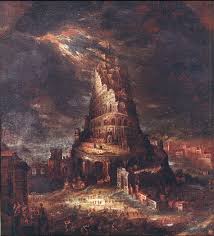
they journeyed from the east, that they found a plain in the land of Shinar; and they dwelt there. . . . And they said, Go to, let us build us a city, and a tower, whose top may reach unto heaven; and let us make us a name, lest we be scattered abroad upon the face of the whole earth.
" Genesis 11:2, 4. 
The leader in this rebellion is supposed to have been Nimrod, whose name signifies the rebellious. 
He was the Belus of the ancients, a great-grandson of Noah, being the youngest son of Cush, a son of Ham. "He began to be a mighty one in the earth. . . . And the beginning of his kingdom was Babel . . . in the land of Shinar." Genesis 10:8, 10. 

Because they stopped in their migration, God confounded their language, that they might not "understand one another's speech. . . . So the Lord scattered them abroad from thence upon the face of all the earth; and they left off to build the city. Therefore is the name of it called Babel; . . . and from thence did the Lord scatter them abroad upon the face of all the earth." Genesis 11:7-9."
Sylvester Bliss

Sunday, April 2, 2023

Nimrod's Empire

"After the language splitting at Babel, many patriarchs who were listed at Babel came out with multiple names (due to the multiple languages). One variation of “Nimrod” was “Ninus,” which is where the name Ninevah comes from—Nineveh and Nimroud.
 
After Nimrod’s death, his kingdom fell apart into petty kingdoms in
certain local areas. Eusebius relates that event closer to home, stating that
Queen Semiramis (which some suggest was the wife of Nimrod) retained power, reigning for 42 years in Assyria, and was known for building projects in Babylon.
Many of the local rulers vied for power in Nimrod’s broken kingdom, controlling bits and pieces of it. Sometime in the aftermath of Nimrod’s death (and possibly Semiramis’ death), a war broke out between two groups of vying kings, as mentioned in Genesis 14:1–9.
And it came to pass in the days of Amraphel king of Shinar, Arioch king of Ellasar, Chedorlaomer king of Elam, and Tidal king of nations, that they made war with Bera king of Sodom, Birsha king of Gomorrah, Shinab king of Admah, Shemeber king of Zeboiim, and the king of Bela (that is, Zoar).
All these joined together in the Valley of Siddim (that is, the Salt Sea). Twelve years they served Chedorlaomer, and in the thirteenth year they rebelled. In the fourteenth year Chedorlaomer and the kings that were with him came and attacked the Rephaim in Ashteroth Karnaim, the Zuzim in Ham, the Emim in Shaveh Kiriathaim, and the Horites in their mountain of Seir, as far as El Paran, which is by the wilderness.
Then they turned back and came to En Mishpat (that is, Kadesh), and attacked all the country of the Amalekites, and also the Amorites who dwelt in Hazezon Tamar. And the king of Sodom, the king of Gomorrah, the king of Admah, the king of Zeboiim, and the king of Bela (that is, Zoar) went out and joined together in battle in the Valley of Siddim against Chedorlaomer king of Elam, Tidal king of nations, Amraphel king of Shinar, and Arioch king of Ellasar—four kings against five. (NKJV)
This is the war that Abraham was dragged into and fought to successfully rescue his nephew Lot (Genesis 14:12–16). By this point in history, these smaller kingdoms were setting the stage for later empires like the Assyrian Empire and so on." AIG

Sunday, February 5, 2023

Josephus on Nimrod

"In Genesis 11:4, the people say, “Come, let us build ourselves a city, with a tower that reaches to the heaven”. 
If Nimrod founded the city of Babel, it is likely he would have been part of this plan.
 
Josephus states of Nimrod,  
“He also said he would be revenged on God, if he should have
a mind to drown the world again; for that he would build a tower too high for the waters to be able to reach and that he would avenge himself on God for destroying their forefathers
”
 
(Antiquities of the Jews, Book 1, Chapter 4)."  
Croswsalk

of Nimrod "before the Lord" means......

"
The phrase "before the Lord" in Hebrew is  ḡibbōr-ṣayiḏ lip̄nê Yahweh. This literally means something like "in the face of the Lord", according to my Hebrew concordance. Nimrod's life "before the Lord" is taken to mean he was brazenly bold in his opposition to God.
Genesis 10:9. Nimrod was a mighty hunter — In the Septuagint it is, He was a giant hunter: — the Arabic has it, He was a terrible giant before the Lord: and the Syriac, He was a great warrior.  
It is probable he began with hunting, and for this became famous to a proverb. 
   He served his country by ridding it of wild beasts, 
   and so insinuating himself into the affections of his neighbors, 
   he got to be their prince. 
And perhaps, 
   under pretense of hunting, 
   he gathered men under his command, 
   to make himself master of the country. 
Thus he became a mighty hunter, a violent invader of his neighbors’ rights and properties." 
BonifaceUSC/BensonCommentary

Epic of Gilgamesh & Nimrod?

The first centers of his kingdom were Babylon, Uruk, Akkad and Kalneh, in Shinar.
Genesis 10:10
 
"The Epic of Gilgamesh is the oldest work of epic literature to be discovered, written on clay tablets. It centers around the great warrior king Gilgamesh, who, depending on the version, was sometimes portrayed as part-god because of his mighty deeds.
Though Gilgamesh was portrayed as a hero, he was also ruthless and depraved. This mighty warrior tyrant king fits the description of Nimrod well. 
In part of the Epic, Gilgamesh speaks with Utnapishtim, a man who survived a great flood sent by the gods by building a boat at the command of the god Ea, seeking to learn immortality from him. Utnapishtim tells a story very similar to the Genesis Flood narrative. This makes sense if it is Nimrod speaking with his grandfather Ham or his great-grandfather Noah.
In another part of the Epic, Gilgamesh sets out to kill the being that caused the flood. This lines up with Nimrod’s defiance of God.
Though the two may be unrelated, similarities make some sort of relationship between Nimrod and Gilgamesh a possibility."
Crosswalk

Nimrod as Marduk?

And Cush begat Nimrod: he began to be a mighty one in the earth. 
He was a mighty hunter before the Lord: wherefore it is said, 
Even as Nimrod the mighty hunter before the Lord. 
And the beginning of his kingdom was Babel, and Erech, and Accad, 
and Calneh, in the land of Shinar.
Genesis 10:8-10
 
"He sought to establish great cities on each river, the Tigris and the
Euphrates, in an attempt to control trade and commerce in the region. 
As he built up his vast network of cities, both on the Tigris and Euphrates rivers, he began to institute religious practices that were directly at odds with the worship of the true God.
Nimrod himself was later deified as Merodach, or Marduk, the chief god of Babylon. 
According to the Babylonian tradition Marduk is a monster-slayer and therefore he can be described as a hero and a great hunter, as is Nimrod in Genesis.
Naturally the stars, and planets, the "heavenly host", became involved with these deities and pagan practices. The sun began to occupy a central place of importance.
The zodiac was created. Astrology became spiritism, and soothsaying, and using the stars to predict events and dates in the future."
IsraelAHistory

Saturday, April 2, 2022

Origin of Baal Worship

"Nimrod is singled out by the voice of antiquity as commencing this
fire-worship. The identity of Nimrod and Ninus ...under the name of Ninus, also, he is represented as originating the same practice. 
 
In a fragment of Apollodorus it is said that "Ninus taught the Assyrians to worship fire." 
 
The sun, as the great source of light and heat, was worshiped under the name of Baal. Now, the fact that the sun, under that name, was worshiped in the earliest ages of the world, shows the audacious character of these first beginnings of apostasy. 
 
-*-According to the primitive language of mankind, the sun was called "Shemesh"--that is, "the Servant"--that name, no doubt, being divinely given, to keep the world in mind of the great truth that, however glorious was the orb of day, it was, after all, the appointed Minister of the bounty of the great unseen Creator to His creatures upon earth. 
 
Men knew this, and yet with the full knowledge of it, they put the servant in the place of the Master; and called the sun Baal--that is, the Lord--and worshiped him accordingly. 
 
What a meaning, then, in the saying of Paul, that, "when they knew God, they glorified Him not as God"; but "changed the truth of God into a lie, and worshiped and served the creature more than the Creator, who is God over all, blessed for ever." (Romans 1:21,25).
 
The beginning, then, of sun-worship, and of the worship of the host of heaven, was a sin against the light--a presumptuous, heaven-daring sin.  
As the sun in the heavens was the great object of worship, so fire was worshiped as its earthly representative."  
Alexander Hislop

Thursday, February 24, 2022

Digging Deep Into the Tower of Babel

"Nimrod founds an empire of naked aggression based in Babylon. 
He is a tyrant, 
a mighty hunter to be feared, 
and most significantly a builder of cities.
 
Babel, like many cities in the ancient Near East is designed as a
walled enclosure of a great temple or ziggurat, a mud-brick stair tower designed to reach to the realm of the gods. 
With such a tower, people could ascend to the gods, and the gods could descend to earth. .....we see in it the self-aggrandizing ambition and escalating sin of pride that drives these people to begin building such a mighty tower. "Let us build ourselves a city, and a tower with its top in the heavens, and let us make a name for ourselves; otherwise we shall be scattered abroad upon the face of the whole earth" (Gen. 11:4).
 
Q: What did they want? 
A: Fame. 
Q: What did they fear? 
A: Being scattered without the security of numbers. 
 
The tower they envisioned building seemed huge to them, but the Genesis narrator smiles while telling us that it was so puny that God "came down to see the city and the tower" (Gen. 11:5).....they intend to use the creative power they possess as image-bearers of God to act against God’s purposes. 
 
In this case, they plan to do the opposite of what God commanded in the cultural mandate. 
--Instead of filling the earth, they intend to concentrate themselves here in one location. 
--Instead of exploring the fullness of the name God gave them—adam, “humankind” (Gen. 5:2)—they decide to make a name for themselves. 
 
God sees that their arrogance and ambition are out of bounds and says, "Let us go down and confuse their language there, so that they will not understand one another's speech” (Gen. 11:7).
 
Bruce Waltke concludes his analysis of Genesis 11 in these words: 

Society apart from God is totally unstable. On the one hand, people earnestly seek existential meaning and security in their collective unity. On the other hand, they have an insatiable appetite to consume what others possess....At the heart of the city of man is love for self and hatred for God. The city reveals that the human spirit will not stop at anything short of usurping God's throne in heaven.

--While it might appear that God’s scattering of the peoples is a
punishment, in fact it is also a means of redemption. 
From the beginning, God intended people to disperse across the world. “Be fruitful and multiply, and fill the earth” (Gen. 1:28). By scattering people after the fall of the tower, God put people back on the path of filling the earth, ultimately resulting in the beautiful array of peoples and cultures that populate it today. 
--If people had completed the tower under a singularity of malicious intent and social tyranny, with the result that “nothing that they propose to do will now be impossible for them" (Gen. 11:6), we can only imagine the horrors they would have worked in their pride and strength of sin. The scale of evil worked by humanity in the twentieth and twenty-first centuries gives a mere glimpse of what people might do if all things were possible without dependence on God."
TOW

Saturday, November 28, 2020

Spiritual / Prophetic Lesson of Nimrod & Abraham

"This account of the apostasy of Israel and their destruction was not written for nothing. These words were written for us, and we must heed them in our day.

Now we come to the last days of Judah. 
Read the books of Jeremiah and Ezekiel. 
They are present truth to-day for Seventh-day Adventists, just as much as is the book of Revelation. 
Jeremiah and Ezekiel are written for us upon whom the ends of the world are come, because these books were written in the days when the end of Judah was come; and the destruction of Jerusalem, and the times that attended it, are simply recorded to point out to all the people of the world the times when the end of the world and its destruction are near, and to warn them concerning the events that will attend it, and the troubles that will accompany it.

There is to-day a Babylon and an Egypt. To-day there are people of
God in Babylon and in Egypt. And to-day the Lord calls, "Come out of her my people;"(Rev. 18:4) and, "Out of Egypt have I called my son." (Matt. 2:14)

Look at it again: 
Q: Where was Nimrod?
A: He was in Babylon, and governed the realm of Babylon. 
 
Q: Where was Abraham?
A: He was in the country ruled by the kingdom established by Nimrod. But God called him out of that country. That country was Babylon both spiritually and physically. And more than this: Nimrod was the son of Cush, and Cush was the son of Ham, and Egypt is the
land of Ham. 
 
So that in Nimrod there was both Egypt and Babylon. And when God called Abraham, he called him out of both Egypt and Babylon. And "if ye be Christ's, then are ye Abraham's seed, and heirs according to the promise." (Gal.3:29) And ye are called out of both Egypt and Babylon."
A.T. Jones

Tuesday, March 28, 2017

Astrological Observation Tower

"Noah and his family disembarked from the Ark and offered a sacrifice to God in thankfulness for
their great deliverance. God responded by giving them the rainbow as the sign of His promise to never again judge the earth with a similar flood. The promise came with the command to fill the earth, certainly through worldwide migration.

It wasn’t long before mankind was again in full rebellion against Him. Under the leadership of wicked Nimrod, they built an astrological observation tower at Babel from which to worship the creation rather than the Creator.

 At that time, all people spoke the same language, and working together, the rebellion-minded members built the tower in open disobedience to God’s migration command, boldly defying Him with the assertion “lest we be scattered abroad upon the face of the whole earth” (Genesis 11:4). Most of the family groups had probably remained together while rapidly multiplying. God could not leave this dual-pronged rebellion unpunished. He confused their language, halted the cooperative rebellious building project, and enforced migration.

 The strongest, most prominent groups, including the forerunners of the Sumerians, the Babylonians, the Akkadians, and the Assyrians, probably remained where they were, forcing the others to leave.
They retained technology that they had previously acquired and founded advanced city states, while other powerful groups claimed the fertile territory nearby—areas with desirable natural resources such as the Nile River basin. The remaining clans migrated where they could, with stronger ones continually displacing the weaker. Some moved south to the African continent, and others moved east to Asia. The Ice Age was spreading across Europe, and groups who moved there were forced to adjust their lifestyles.

Genesis 10 records these migration routes, mentioning the incipient nations and territory.
In general, the Semites—descendants of Shem—retained control of the region of Mesopotamia, while the Japhethites migrated toward the northeast and northwest into Europe and Russia, and the Hamites moved south into Africa and east into Asia.

All groups took with them the knowledge of God, the Flood, and proper worship, as well as the false worship practiced at Babel. Many new civilizations constructed similar towers or pyramids and began worshiping the stars, using the same imaginary star pictures in the Zodiac. Written scripts were rapidly developed in numerous areas, using completely different systems and symbols.

Tribes living in the harsh environment of Ice Age Europe often lived in caves for safety and warmth, all the while losing pieces of their once-common knowledge as they adopted a hunter-gatherer mode of existence. Simultaneously, numerous budding civilizations accomplished great engineering feats that perhaps even today would be difficult to duplicate. These early people were hardly the ignorant subhumans that we often see depicted as recently evolved from the animals. Man was smart at the start because he had been created that way." ICR

Thursday, April 23, 2015

Battlefield Earth Series - Babel (Beginning of the post-flood rebellion)

And they said, Go to, let us build us a city and a tower,
whose top may reach unto heaven;
and let us make us a name,
lest we be scattered abroad upon the face of the whole earth.
Genesis 11:4
---3---
3 Goals:
-1- A City
-2- A Tower
-3- A Name

The post-flood rebellion began with the city of Babel. The post-flood rebellion ends with the fall of Babylon. Also, the city was in direct rebellion against the word of God - Be fruitful, and multiply, and replenish the earth. Genesis 9:1

The tower they tried to build up to heaven by their own might. So too does the sins of Babylon in the end reach unto heaven - For her sins have reached unto heaven, and God hath remembered her iniquities. Revelation 18:5 We don't need a man-made tower...we already have a strong tower - The name of the LORD is a strong tower: Proverbs 18:10

The name they tried to make for themselves was rooted in pride...pride is how this war all began - How art thou fallen from heaven, O Lucifer,..For thou hast said in thine heart, ...I will ascend above the heights of the clouds; I will be like the most High. Isaiah 14:12-14

Root of this REBELLION----- Pride goes before destruction, And a haughty spirit before a fall. Proverbs 16:18
In his pride the wicked man does not seek him; in all his thoughts there is no room for God.
Psalm 10:4 NIV

* Nimrod, founder of Babel, is a type for Lucifer, founder of spiritual Babylon. As Nimrod was a mighty hunter before the Lord, so too was Lucifer a mighty angel before the Lord....
Even as Nimrod the mighty hunter before the LORD.
And the beginning of his kingdom was Babel,
Genesis 9:10,11
...the workmanship of thy tabrets and of thy pipes was prepared in thee in the day that thou wast created.  Thou art the anointed cherub that covereth; and I have set thee so: thou wast upon the holy mountain of God; thou hast walked up and down in the midst of the stones of fire.
Ezekiel 28:13,14

Thy terribleness hath deceived thee,
and the pride of thine heart,
...though thou shouldest make thy nest as high as the eagle,
I will bring thee down from thence,
saith the LORD.
Jeremiah 49:16