
"To believe the evolutionary story, one has to presume that early grunts gave rise to thousands of complex languages with syntax, grammar, and semantics: the ability to arrange complex thoughts into words by primitive humans freshly emerging from apedom.
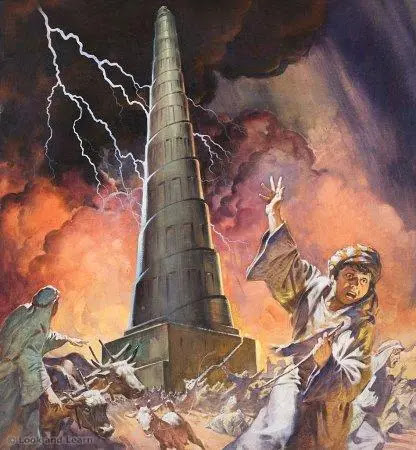
--Instead, scientists are finding a steady decline in languages that continues to this day. This fits the Genesis 11 account of a high diversity of languages beginning at the Tower of Babel.
The rise and fall of language diversity through the Holocene (Blasi et al., Science Magazine, 23 July 2026). The history of language, these researchers say, is one of loss, not gain. The Editors’ Summary of the paper by Bianca Lopez says,
"More than four languages are lost every year, and this rate is predicted to increase. Blasi et al. investigated how language diversity has changed over the Holocene using a Bayesian modeling approach, ethnographic data, and estimates of the total human population size over time. They assumed a maximum size of ethnolinguistic groups and that the number of different ethnolinguistic groups is related to the number of languages. Their findings suggested that language loss is not a new phenomenon, and that language diversity has been decreasing rapidly over the past one to three millennia following a peak of an order of magnitude higher diversity than we see today."
Estimating the number of languages in ancient history is admittedly speculative, riddled with assumptions. Nevertheless, it is interesting that evolutionary linguists arrive at a story of decline of language diversity rather than progress from few to many languages. Using the evolutionary timeline, the authors state:
"In the absence of direct evidence, researchers have speculated on the global trajectory of the total number of languages over the Holocene. The Megadiverse Paleolithic Hypothesis suggests that the total number of languages has been declining over the last 12,000 years, when agriculture-led language expansions began replacing hunter-gatherer language diversity. Although peak numbers are unknown, estimates range between 12,000 and “tens of thousands” of languages just before the advent of agriculture; such estimates extrapolate from the diversity now found only in New Guinea and Vanuatu. Under this view, proximate causes of the current linguistic diversity crisis (such as warfare, genocide, and the expansion of colonial powers along with their languages, cultures, and pathogens) have accelerated a process of language loss already in place throughout much of the Holocene."

The Genesis record portrays mankind speaking from the beginning. It’s a manifestation of the body and mind of humanity granted by their creation in the image of God. Genesis presents a top-down picture of language: originally one language, but purposely diversified at Babel due to sinful man’s disobedience to God’s order to multiply and fill the earth as stewards of the creation.
To the evolutionist, all of our exceptional capabilities require explaining by gradual material processes.
Q: Do these authors give an account for the origin of language?
A: Not really; they assume that groups of humans each had their own languages, and there were lots of them. Their only graph of the Holocene begins with thousands of languages already being used.
"Before the onset of plant and animal domestication, the number of languages was smaller than it is today (4500 to 6000 compared with 7500). Subsequent increases in global population precipitated increased linguistic diversity. We uncovered a linguistic “golden age” with tens of thousands of languages 3000 to 1000 years ago. Great loss of linguistic diversity did not begin with recent colonial expansion but as multinational empires first spread along with their languages, pathogens, and cultures. Thus, extinction has likely played a much greater role in shaping linguistic and cultural diversity than previously thought."
This simply begs the question. Language is assumed to exist at the beginning, then it declines. This assumption offers no explanation for complex communication using rational thought. It’s like assuming a biosphere full of life, then spending a whole paper explaining how most of it went extinct.
Humanity spoke thousands of languages at the dawn of farming — now many of them are lost (Nature News, 23 July 2026). Nature commented on this paper, agreeing that language extinction has been the main trend throughout human history. It’s a crazy way to look at evolution, reports Freda Kreier for Nature:
"Humanity might once have spoken many more languages than it does today, with tens of thousands in use between 3,000 and 1,000 years ago. This far exceeds the more than 7,500 unique languages now used worldwide."
The findings, published on 23 July in Science, suggest that the rise of agriculture spurred an initial language boom as people shifted from a nomadic, hunter-gatherer lifestyle and settled into small, isolated communities. If accurate, these results suggest that language extinction is not a uniquely modern phenomenon, says Heidi Harley, a linguist at the University of Arizona in Tucson.
The true historical diversity of languages suggested by this analysis is “mind-blowing”, she says. “The sheer number of languages that they projected to have existed is like, ‘What? That’s crazy’.”
Indeed, it is rather crazy to think that language is an evolutionary product of mindless, thoughtless, irrational material processes.
Notice the “suggestion” that “the rise of agriculture spurred” a language boom.
Indeed, it is rather crazy to think that language is an evolutionary product of mindless, thoughtless, irrational material processes.
Notice the “suggestion” that “the rise of agriculture spurred” a language boom.
Q: How did a spur arise, and what made it drive the horse to speak?
Or you can get smart and read the Bible, where people act like real people, and complex things like human language have a rational source: a Mind with power, foresight, and purpose, whose works are revealed in history." CEH

.webp)


.jpg)
.jpg)
.jpg)
.jpg)